The House That Changed Winter Park's Historic Preservation Rules
September 24, 2026
September 24, 2026
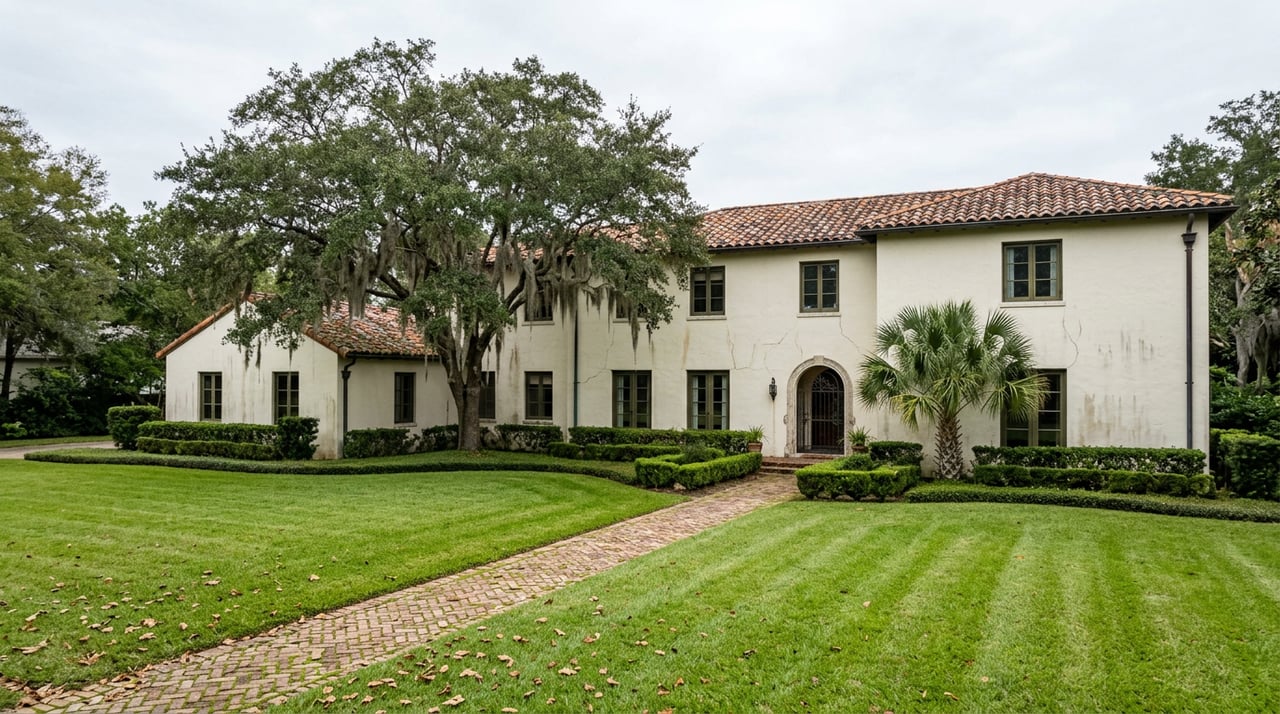
Drive down Lakeview Drive along Lake Virginia today and one address still draws a second look. In May 2024, a 1936 home in the College Quarter Historic District went from a modest renovation project to a cautionary tale in the span of a few days, when a contractor demolished nearly the entire structure after receiving approval to take down only a detached garage. What was left standing was a chimney and a sliver of the first floor.
That single incident rewrote the rules for anyone who owns, buys, or renovates an older home in Winter Park. If you are considering a pre-1976 property in College Quarter, the Vias, or the streets ringing Lake Osceola and Lake Virginia, the version of the ordinance you need to understand is not the one your inspector or contractor learned five years ago. It is the one the City Commission passed in 2025, and it changes the math on what a construction mistake actually costs.
The builder, Charlie Clayton of Charles Clayton Construction, went before the Historic Preservation Board and apologized. He told the board he went door to door in College Quarter to explain what had happened. The board had authorized a design that brought the home to 7,200 square feet, contingent on removing only the garage. Instead, all but a small portion of the first floor and the chimney came down.
Under the ordinance as it existed then, the board had two real options. It could require the homeowner and contractor to rebuild the house exactly as it stood, stripping the variances that had made the larger addition possible in the first place. Or it could negotiate a payment and let the project continue as designed. The board chose the second path. Clayton paid $100,000 into the Historic Preservation grant fund the next day, and construction resumed.
John Skolfield, a builder who was later elected chairman of the Historic Preservation Board, put a number on what the harsher option would have meant for that specific house. Losing the variances and rebuilding without them, he told the City Commission, would have been a $500,000 to $800,000 swing on that project alone.
That gap between a six-figure fine and a six-figure rebuild is the entire reason Winter Park spent a year arguing about this ordinance.
In May 2025, the City Commission approved revisions designed to close the gap between the two outcomes and remove the option to simply negotiate a payment on the fly. The commission passed what city staff called Version 1 on a 4-1 vote. Under the new language, an owner who demolishes or dramatically alters a historic structure without authorization, after already going through the certificate of review process, can be required to rebuild the structure exactly as it was, using authentic exterior materials, and can lose any variances the board had granted for the project.
Commissioner Marty Sullivan cast the lone dissenting vote. He preferred an alternative version that paired the rebuild requirement with an explicit financial penalty capped at 30 percent of the property's county-assessed value, and he argued publicly for raising that cap to 60 percent. The commission passed the version without the added fine structure, on the theory that the rebuild-and-lose-your-variances consequence was penalty enough.
| Before May 2025 | After May 2025 | |
|---|---|---|
| Unauthorized demolition or major alteration | Board could negotiate a payment and allow the project to continue | Owner can be required to rebuild exactly as it was, in authentic materials |
| Variances granted for the original design | Typically preserved once a settlement was reached | Can be revoked entirely |
| Application process | Design review after plans were largely set | New pre-application review lets owners get feedback before spending on renderings |
| Demolition scope | Could shift after work began | Owners must submit a due diligence assessment listing all proposed demolitions or alterations up front |
The practical effect for anyone buying a fixer-upper in a Winter Park historic district: an unauthorized demolition that once led to a six-figure payment can now cost the entire value of the variances that made the project pencil out in the first place.
Here is the detail that catches people off guard on the buying side, and it has nothing to do with the ordinance's penalties. Winter Park's Historic Preservation Board only has jurisdiction over properties that are locally designated, either individually or as part of a historic district. A home can be more than a century old, sit on a street full of architecturally significant houses, and carry zero protection from demolition if no one has ever applied for that designation.
The city's own criteria for designation only requires that a property be at least 50 years old and possess architectural, aesthetic, or historical value. Passing that bar is easy for hundreds of Winter Park homes. Actually being on the register is a separate, voluntary step, and plenty of significant houses have never taken it.
That gap became visible again this year. Three homes designed by architect James Gamble Rogers II, widely credited with shaping much of Winter Park's residential character, faced demolition within the same twelve-month period. None of the three were listed on the city's historic register, which meant none had any procedural protection at all. The Winter Park Voice reported that Betsy Owens, executive director of Friends of Casa Feliz and Rogers's granddaughter, called them irreplaceable works by the architect who more than any other defined the visual character of Winter Park, and pushed the commission to treat the losses as a wake-up call.
The most visible of the three is Merrywood, the roughly 90-year-old estate at 1020 Palmer Avenue on a 3.67-acre lakefront parcel. The prospective buyer had the property under contract and asked the city to split the lot. The proposal would allow a new home on part of it while the historic house was marketed on the remainder. After months of marketing with no buyer willing to take on the restoration, the City Commission voted 3-2 in June 2026 to approve the comprehensive plan change, with conditions limiting the combined square footage of any new construction and requiring at least one new home to echo Rogers's style. The property sold in mid-August 2026 for $15 million to an LLC formed the same month, and the house's future remains unresolved.
Merrywood is not a preservation ordinance failure in the way the Lakeview Drive house was. Nobody demolished it without permission. It is simply a house with no local designation sitting on land worth many multiples of the structure itself, in a city where that pattern is not new. An analysis by the Casa Feliz Preservation Advocacy Committee found that more than 1 in 8 single-family homes in Winter Park, 1,066 of 8,440, were demolished between 1993 and the time of that study, roughly double the national rate. The oldest, most character-rich streets in Winter Park are also the ones sitting on the most valuable dirt, and that tension predates the current ordinance by decades.
If a historic review is already part of your timeline, one more permitting layer for older Winter Park lots is worth building into your schedule from the start.
If a house sits in a district but its contributing status is unclear, confirming that status early avoids a permit application stalling mid-process.
For a pre-1976 home in College Quarter, the Vias, or the historic streets around Lake Osceola and Lake Virginia, a few questions are worth answering before either side signs anything.
Does listing on the National Register of Historic Places stop a home from being demolished? No. National Register listing is largely honorary for private owners and does not by itself restrict demolition or alteration unless federal funds or federal permits are involved. Local designation through the city's own register is what triggers design review and demolition restrictions in Winter Park.
If a home is 50 years old, is it automatically protected? No. Age alone makes a property eligible for local designation, since the city's threshold is 50 years plus architectural, aesthetic, or historical value. Eligibility is not the same as designation. A home has to actually go through the process, and many architecturally significant Winter Park homes never have.
How long does historic review add to a purchase or renovation timeline? It depends on scope and whether pre-application review is used. The new pre-application step is designed to catch problems before a buyer or owner spends money on detailed renderings, which can save time overall even though it adds a step at the front end.
If you are weighing an older home in Winter Park, whether you are trying to protect its character or evaluate what a lot is really worth once the structure is accounted for, the ordinance details above are the kind of thing that belongs in your due diligence conversation before you write an offer, not after. ELUXE Realty works through exactly this kind of research with clients across Winter Park's historic districts. Schedule a private consultation and we will walk your specific address through what applies and what doesn't.
This article is general information, not legal, tax or financial advice. Consult a qualified professional about your situation.
Stay up to date on the latest real estate trends.

Work with Eluxe Realty and experience a refined, client-first approach to luxury real estate, where innovation, precision, and white-glove service come standard.